



Day 5

I came home one day to find long legs sticking out from under our son’s truck. “What are you doing?” I asked. “Changing the oil,” was his reply. It’s important to note that neither Dale nor I are handy when it comes to cars. Whenever something happens, or even just regular maintenance needs to happen, we take our vehicles to the service department at the dealership. I have been a AAA member for 30+ years. When my car is acting up, or I’ve once again run out of gas, I don’t call Dale. I call AAA. So you can imagine my surprise when I heard that Andrew was doing something I would never begin to attempt and that neither his father nor I had taught him to do. My next question was, “How in the world did you learn to change oil?” His reply? “I YouTubed it.”
Our youngest son has always known how to do things (like changing the oil in a car) that we didn’t teach him and he didn’t read about in a book. We are regularly impressed by his practical knowledge. How does he seem to “just know” these things? He can learn anything just by watching someone else do it and explain the steps. His dad says he is a Suma Cum Laude graduate of YouTube University!!
In our reading today, a new friend of Jesus’ is impressed by His knowledge. It seems that Jesus has supernatural abilities and this friend wonders out loud how someone from Nazareth could possibly know such things. Jesus responds, “This is nothing! Just you wait!”
Read John 1:43-51
Nazareth was an insignificant, even despised, town. Even fellow Galileans looked down on Nazareth, as is evident in the response of Nathanael when Philip told him about finding the Messiah, “Can anything good come out of Nazareth?” (v 46) Nathanael could not believe that the promised Savior would come from “that neck of the woods.” And if you are confused, Nathanael is likely the same person as Bartholomew, who is listed among Jesus’ twelve disciples in the Synoptic Gospels. Bartholomew actually means “son of Tolmai,” so his full name would have been Nathanael, son of Tolmai.
If Nathanael had been a better student of the Hebrew Scriptures, or the Old Testament, he would not have been so surprised that the Messiah would come from Nazareth. The prophet Isaiah wrote that the Messiah would have “no form or majesty” and would be “despised and rejected by men.” (Is 53:1-3) His upbringing in Nazareth, therefore, was one of the ways in which Isaiah’s prophecy was fulfilled. The Messiah, who would be despised by the majority of His own people, began life as a citizen of a town other Galileans made fun of.
While Nathanael found it difficult to believe that the Messiah could actually come from Nazareth, he agreed to go with Philip to see for himself. Jesus greets the men by addressing Nathanael as “truly an Israelite in whom there is no deceit!” (v 47). Jesus saw no ulterior motives in Nathanael’s visitation. Nathanael was coming to figure out who Jesus was and whether Philip was right about Him, and he was not hiding that fact from others.
“How Do You Know Me?”
Nathanael was surprised that Jesus could see the truth of his intentions, for how could an ordinary man see into another’s heart? But Jesus then offered further proof that He was no ordinary man by telling Nathanael, “Before Philip called you, when you were under the fig tree tree, I saw you.” (v 48) It is not exactly clear what Jesus meant by this statement. R.C. Sproul suggests that there are two possible meanings. Jesus could have just seen Nathanael sitting in the shade of a literal fig tree. But it could also be that Jesus meant that he saw Nathanael sitting at his home, for ancient Jews sometimes used the term “fig tree” as a metaphor for a person’s house. Either way, Nathanael recognized that Jesus saw something about him that required supernatural knowledge because Jesus had never met him before. Thus, Nathanael recognized Jesus as the Son of God and King of Israel, the One invested with divine authority to rule and reign as Messiah when he proclaimed, “Rabbi, You are the Son of God, you are the King of Israel. “(v 49).1
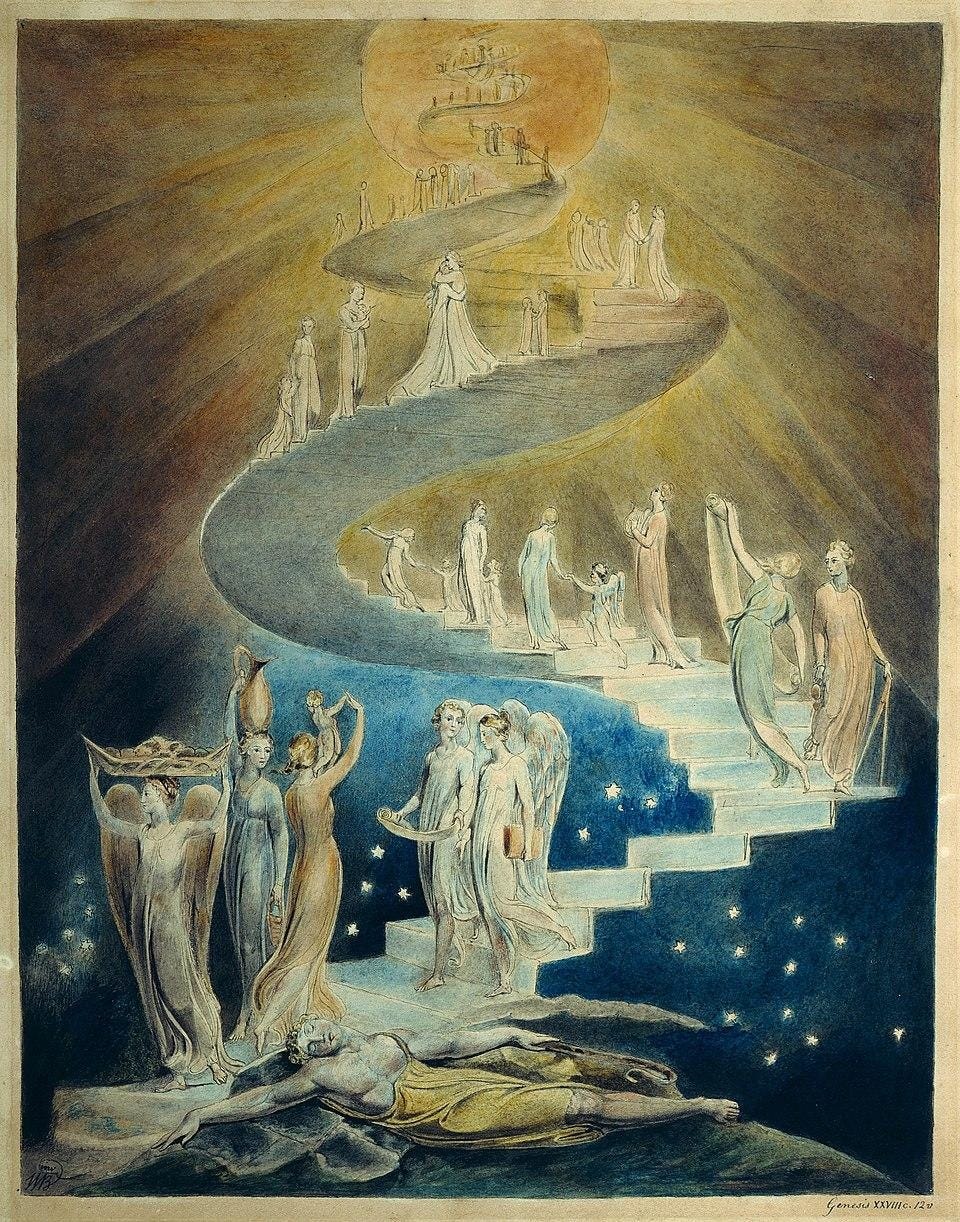
As great a sign as supernatural insight was, Jesus’ response to Nathanael was that he would yet see something greater, when he would see “heaven opened, and the angels of God ascending and descending on the Son of Man” (vv 50–51). Here Jesus shares a clear allusion to Jewish patriarch Jacob’s dream of a ladder or staircase joining earth and heaven (Gen 28:10-22). Jesus was telling Nathanael that He is the link between earth and heaven. If a person is to ascend to heaven and attain salvation he must do it through Him! Nathanael witnessed Jesus’ display of supernatural knowledge, which was no doubt incredible. But Jesus’ reply, that He, Jesus the Messiah, is actually, the staircase to heaven, blew Nathanael away.
“This is nothing! Just you wait!”
Big Picture Questions for Today:
Nathanael quickly concluded that Jesus was the Son of God, the Messiah, because of His ability to see beyond the obvious and natural. How about you? When you hear of supernatural happenings or even experience them yourself, do you credit God or fate/coincidence/luck?
Jesus’ humble origins are one of the clearest indications that His kingdom is not of this world. He came in humility, showing us that God’s view of greatness is in many ways different from what the world tells us is great. “Can anything good come from Nazareth?” How do you measure greatness? By the world’s standards - accomplishment, net worth, physical strength? Or by God’s standards, who “has chosen what is foolish in the world to shame the wise, and God has chosen what is weak in the world to shame the strong.” (1 Corinthians 1:27)?
Pray and thank God for the continuity of the gospel of grace woven through scripture; the beautiful picture of Jesus being that staircase to heaven that Jacob saw in his dream thousands of years before.
R.C. Sproul, Ligonier Devotionals “Good From Nazareth, John 1:43-46” (January 17, 2018) https://learn.ligonier.org/devotionals/good-from-nazareth.


