



Day 22
In 2003, then 2-year-old Brandon Connor was diagnosed with neuroblastoma, one of the deadliest forms of childhood cancer, with a tumor growing near his spine. The tumor was supposed to be removed in a dangerous surgery that risked paralysis. However, according to an Associated Press report by Alicia Chang, on the eve of the surgery a scan showed the tumor had essentially vanished, replaced only by fatty tissue, leaving doctors without a medical explanation for the sudden disappearance1. You can feel the shock, the awe, the inexpressible gratitude and almost hear the doctor declare, “All I know is that it was there and now it’s gone.”

We’ve all heard of these bizarre happenings. Perhaps we’ve even experienced or witnessed one ourselves; these documented cases of unexplainable healing that often leave medical professionals stunned, challenging the known limits of human biology and modern medicine. Sometimes referred to as spontaneous remission or medical miracles, they occur in patients who were terminal, severely injured, or diagnosed with incurable conditions. What explanation is there? Only that what was once incurable is no longer.
In today’s reading we see a trend developing. Beginning in chapter 5, where He healed the lame man at the pool of Bethesda, Jesus is accomplishing unexplainable healings after years of disability. In addition, He is also giving victory over sin and hope for eternal life, but there is a problem with Jesus’ timing. He is giving sight to the blind and rescuing folks on the Sabbath, with no regard for the extra rules regarding this most holy day of the week. As with so many of Jesus’ teachings, He uses the physical and material to communicate spiritual truth. When should that truth be best expressed but on the Sabbath? The Sabbath, when God’s people are not frenetically rushing about, working to provide food and shelter for their families, but instead have time and space to be more thoughtful and engage with the things of God? According to the experts, absolutely not!
Read John 9:13-41
Jesus continues to do God’s work of healing and restoration on the Sabbath and the religious leaders are feeling threatened and out of control. How dare Jesus of Nazareth come into their space and begin to change the rules. He continues to slip through their grasp, so they decide to pursue a different angle. Jesus may be getting away with going rogue in the streets with the common people, but He doesn’t have authority in the synagogue. They decide who stays in good standing, NOT JESUS! So they round up the once blind man and basically put him on trial. They begin their interrogations by demanding, “Explain to us how you can see?” (from v 15) For the first time in this man’s life, he is seen and addressed by men of importance. For the first time in his life, he is able to look those men straight in the eye and answer, “He put mud on my eyes. I washed and I can see.” (v 15)
So who is on trial here and what is the crime? Jesus is the one who has committed the egregious sin of once again, healing someone on the Sabbath, who claimed to be “the light of the world.” (Jn 9:5) and was thereby declaring His direct connection with God. The sighted man simply shared his personal testimony of being healed. He didn’t challenge the Pharisees’ authority. But he recognizes his miraculous healing as a demonstration of Jesus Christ’s spiritual authority and that’s where he crossed a serious line. The sighted man was on trial for telling the truth about Jesus.
The group of Pharisees that thought Jesus was not from God believed he violated the Sabbath by healing on it. Because in order for someone to truly be from God they needed to obey God’s commands! But the problem was the Pharisees believed that you had to follow all of their rules in order to keep the Sabbath. You had to keep the Sabbath the way they wanted you to in order to be obedient to God. The Pharisees were notorious for adding to what it meant to keep the Sabbath.
It’s like if someone had a personal rule that when the gas gauge in their car dipped below ½ full, they automatically pulled into a gas station and filled it back up, so as not to risk running out of gas. Because this practice guaranteed that they would never run out of gas, they began to rigidly enforce that rule upon their friends and family and eventually in their minds, that rule was so important, so significant that, if you let your gas tank get to even ¼ full, according to them and their made up rules, you just broke the law.
That’s similar to what was going on with the Pharisees. They had all these additional rules that were set up to help people avoid breaking the Sabbath. But at some point, their rules were synonymous with Sabbath keeping. Their made up laws were anything but helpful. They were burdensome. Their rules were so out of control that they actually believed healing someone was a violation of the Sabbath.
“Again they asked the blind man, ‘What do you say about him, since he opened your eyes?’ ‘He’s a prophet,’ he said.” (v 17) Wrong answer! The Pharisees conclude that despite the sighted man’s testimony, someone is lying; there is no way he was born blind, so they call his parents in to be questioned next. They know the answers to the interrogators’ questions. They offer some answers to the easy questions, “We know this is our son and that he was born blind.” (v 20) But the question of how he now sees? They pass the buck off to their now sighted son. Talk to him. He knows. They’re not willing to say what they certainly know.
They basically plead the fifth. We’ve all seen those moments whether in a U.S. courtroom or perhaps in a congressional hearing, a witness invokes their fifth amendment right. Which means they simply refuse to answer any questions. How does that normally fair for the person invoking their fifth amendment right? Do we all assume they have no idea and don’t know any additional information? No, normally when it seems that someone is refusing to answer a question we all automatically assume that they’re hiding something! Or they know if they explain everything they’re culpable and something bad will happen to them if they tell the truth!
That’s what’s really going on with the healed man’s parents. They’re just refusing to answer the questions and then we read why, “His parents said these things because they were afraid of the Jews, for the Jews had already agreed that if anyone confessed his as Messiah, he would be banned from the synagogue.” (v 22) This healed man’s parents were so afraid of disrupting the status quo, so intimidated by the Jews and Pharisees’ threat of excommunication, they refused to speak up on their son’s behalf.
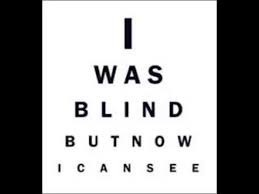
It seems that their interrogation of the parents produced the desired result. The Pharisees were succeeding in dividing a family. They bring the sighted man back, intending to intimidate him into silence like they did with his parents, or at the very least want him to admit that Jesus is a sinner. But notice how he responds, “Whether or not he’s a sinner, I don’t know. One thing I do know: I was blind, and now I can see!” (v 25) Basically he admits that he doesn’t know much, but this one thing he is sure of - he was blind but now he sees!
Because the sighted man refused to tell the authorities what they wanted to hear, they threw him out, or excommunicated him from the synagogue. Again, this was their courtroom, their rules, their decision stands. These toxic beliefs in Jesus would not be allowed to permeate their house of worship.
When Jesus heard of the sighted man’s banishment from Jewish community, He found him and asked, “Do you believe in the Son of Man?” (v 35) Jesus’ greater sign of His divinity was to open the spiritual eyes of people who had faith to believe. The man who had received sight to his blind eyes was ready to receive a spiritual healing as well. The eyes of his heart which had been just as blind as the eyes on his face were opened that day and will be for all eternity!
“The god of this age has blinded the minds of the unbelievers to keep them from seeing the light of the gospel of the glory of Christ, who is the image of God. For we are not proclaiming ourselves but Jesus Christ as Lord, and ourselves as your servants for Jesus’s sake. For God who said, ‘Let light shine out of darkness,’ has shone in our hearts to give the light of the knowledge of God’s glory in the face of Jesus Christ.” (2 Corin 4:4-6)
Big Picture Questions for Today:
Are you willing to testify of Jesus Christ’s work in your life even in the face of adversity? Of potential loss of favor and acceptance of those in positions of power?
Are you, like the sighted man’s parents, more committed to the status quo than to the truth?
It happens in every sphere doesn’t it? It’s true in many personal, church and work settings. So many refuse to speak out because they are intimidated by the thought of what might happen if they tell the truth.
Pray along with the Apostle Paul from his letter to the believers at Ephesus, “that the God of our Lord Jesus Christ, the glorious Father, would give you the Spirit of wisdom and revelation in the knowledge of him. I pray that the eyes of your heart may be enlightened so that you may know what is the hope of his calling, what is the wealth of his glorious inheritance in the saints, and what is the immeasurable greatness of his power toward us who believe, according to the mighty working of his strength.” (Eph 1:17-19)
And finally, enjoy this song, “Open the Eyes of My Heart,” written by Paul Baloche in 1977 and performed by Michael W. Smith.
OPEN THE EYES OF MY HEART (Worship Forever 2021) - Michael W. Smith
Alicia Chang, “Doctors Ponder Medical Miracles” Associated Press: Dec. 22, 2003. https://www.nbcnews.com/health/health-news/doctors-ponder-medical-miracles-flna1c9445809.


