



Day 39
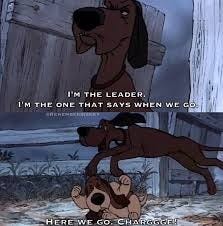
In Walt Disney’s 1970 animated musical comedy, The Aristocats, a family of aristocratic cats are set to gain their mistress’s fortune, much to the dismay of her butler, Edgar. He concocts what he deems a flawless plan; he drugs and kidnaps mother, Duchess, and her three kittens, Berlioz, Toulouse and Marie and drives them out to the Parisian countryside, in hopes of never seeing them again. End of story, or as the French say, “C’est fini.” However two retired army dogs, Napoleon and Bonaparte, make Egar’s sidecar capsize on the country, spilling the cats out under a bridge. Hound dog Napoleon outranks the short and stocky basset hound, Bonaparte, and never misses an opportunity to lord it over him, regularly reminding him, “I’m the leader! I’ll say when we charge!” followed by a quick, “Charge!” Napoleon has convinced himself that his authority within the French Canine Army is for life. While Napoleon is a minor character in the story, this theme of arrogant authority is woven throughout the film, even in the final credits, after Duchess and the kittens are helped by feral cat Thomas O’Malley and return to their mistress’s home. Bonaparte says to Napoleon, “Hey Napoleon! It looks like that’s the end!” To which Napoleon replies, “Wait a minute! I’m the leader! I’ll say when it’s the end…It’s The End.”
There are several moments in today’s reading from John’s gospel in which characters think the story is finished, believing that they have the power and authority to determine when it is “The End.” But Jesus would have the last word.
Read John 19
Caiaphas and his fellow chief priests…Pilate…the Roman soldiers…the Jews…each of these believed that they had power over the outcome of Jesus’ trial, conviction and sentencing. Caiaphas would have rathered a known revolutionary and murderer, Barabbas, be released from prison in celebration of Passover rather than Jesus. Guilty, sinful Barabbas was set free. Jesus took his place.
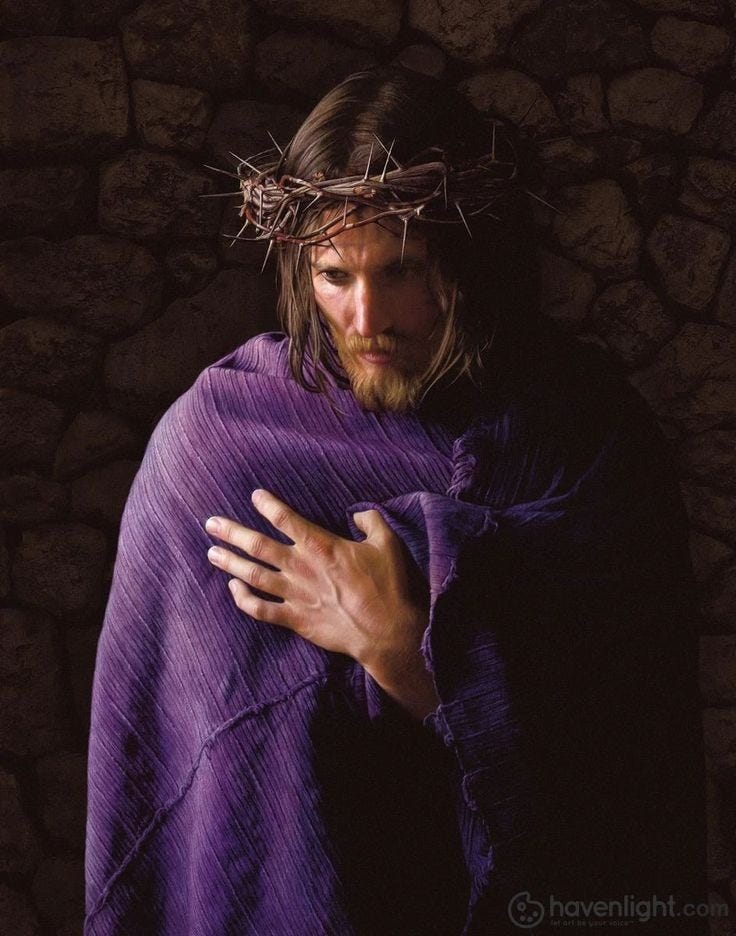
In order to appease the chief priests, Pilate had Jesus flogged by his soldiers. There is uncertainty as to whether this was the only flogging or a first, lighter beating which took place before Pilate sentenced Jesus to death by crucifixion. Some interpreters think this first beating is the same as the severe “scourging” that Jesus received, as described in Matthew’s and Mark’s gospel accounts. However, it seems unlikely that Pilate would have administered so violent and severe a punishment to someone who had not yet been condemned to death and whom Pilate was still trying to release, “I find no grounds for charging him.” (v 4) It seems more likely, therefore, that this flogging was what the Romans called fustigatio, the lightest form of flogging administered for minor crimes. Pilate expected that the crowd would be satiated when Jesus was brought out to them, mocked as “The King of the Jews” replete with a crown of thorns thrust into His skull and a royal purple robe. This whole messy business would be over, finished.
The chief priests and temple servants were enraged when they heard that Pilate found no grounds to execute Jesus, so they played the God card explaining, “We have a law…and according to that law he ought to die, because he made himself the Son of God.” (v 7) Pilate went back into his headquarters to ask Jesus a few more questions. When Jesus refused to answer, Pilate arrogantly proclaimed, “Don’t you know that I have the authority to release you and the authority to crucify you?” (v 10) Didn’t this guy know that Pilate was in charge here? He would say when it was over?
Pilate brings Jesus outside where the crowd can see. He doesn’t seem to know what to do with Jesus, so he throws his hands up in the air and says, “Here is your king!” (v 14) The chief priests aren’t having it and declare, “We have no king but Caesar.” (v 15) What? No king but Ceasar? It was at this point that Pilate hands Jesus over to be crucified (from v 16) and is most likely when the administration of the Roman verberatio took place, more like the scourging that Matthew and Mark describe - the most horrible kind of beating, administered in connection with capital punishments, including crucifixions. Surely this is the end, but no. “Carrying the cross by himself, he went out to what is called the Place of the Skull, which in Aramaic is called Golgotha.” (v 17)
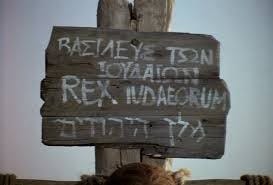
Pilate has a sign made for Jesus’ cross that reads “JESUS OF NAZARETH, THE KING OF THE JEWS” in Aramaic, Latin and Greek. The chief priests, wanting to manage the public relations messaging of Jesus’ sentencing, have problems with the sign. It should say that Jesus claimed to be the King of the Jews. At this point, Pilate has had enough and refuses to make any more changes. It is finished…well Pilate’s part is finished.
I have to say that I trust John’s account of everything that occurred from Jesus’ arrest up to His death more than the other gospel writers. Now don’t hear me saying that I believe there is anything false in the Synoptic gospels, but John was actually there, following closely as Jesus was drug before the Sanhedrin, then Pilate. He walked with the women to the Place of the Skull and was with them as the soldiers nailed Jesus’ hands and feet to the cross and hoisted him up for all to see - bloody, naked, in agony. John, the disciple Jesus loved, was the only one there. There are details in John’s account that simply aren’t included in the Synoptics. Jesus’ provision for His mother Mary is one of those important details. He looked down on His mother and John and said, ‘here is your son…here is your mother. And from that hour the disciple took her into his home.” (v 27) There is credibility to John’s account, “He who saw this has testified so that you also may believe. His testimony is true, and he knows he is telling the truth.” (v 35)
And now, now that all Scripture had been fulfilled, Jesus said, “‘It is finished.’ Then bowing his head, he gave up his spirit.” (v 30) Jesus said when it was The End.
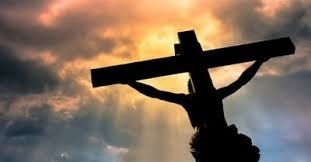
There are no Big Picture Questions today. Instead, I’d like to leave you with one of my favorite prayers from the collection of Puritan prayers and devotions, The Valley of Vision.1 The Puritan Movement was a religious phenomenon spanning the sixteenth and seventeenth centuries. This small book draws from the largely forgotten deposit of Puritan exercises, meditations and aspirations. While the language might seem a bit clunky, I’d like to encourage you to read the prayer aloud, and picture in your mind’s eye the scene. Make this your prayer today.
THE PRECIOUS BLOOD
Blessed Lord Jesus,
Before thy cross I kneel and see
the heinousness of my sin,
my iniquity that caused thee to be ‘made a curse’,
the evil that excites the severity of divine wrath.
Show me the enormity of my guilt by
the crown of thorns,
the pierced hands and feet
the bruised body,
the dying cries.
Thy blood is the blood of incarnate God,
its worth infinite, its value beyond all thought.
Infinite must be the evil and guilt
that demands such a price.
Sin is my malady, my monster, my foe, my viper,
born in my birth,
alive in my life,
strong in my character,
dominating my faculties,
following me as a shadow,
intermingling with my every thought,
my chain that holds me captive in the empire of my soul.
Sinner that I am, why should the sun give me light,
the air supply breath,
the earth bear my tread,
its fruits nourish me,
its creatures subserve my ends?
Yet thy compassions yearn over me,
thy heart hastens to my rescue,
thy love endured my curse,
thy mercy bore my deserved stripes.
Let me walk humbly in the lowest depths of humiliation,
bathed in thy blood,
tender of conscience,
triumphing gloriously as an heir of salvation.
Lastly, enjoy this beautiful song “All Sufficient Merit” written and performed by Shane and Shane. Pay attention to the chorus lyrics:
It is done, it is finished, no more dеbt I owe
Paid in full, all-sufficient merit now my own
All Sufficient Merit (Live) | Shane & Shane
Arthur Bennett, The Valley of Vision: A Collection of Puritan Prayers and Devotions (Banner of Truth Trust: Edinburgh, Scotland, 1975).


